Click on the tiles below to interact with projects I developed on my journey to earning an Instructional Design and Technology Master’s program at Walden University. Project links will take you outside website. Return here when you are done to continue browsing!
Project #1
Challenge: Pitch an educational technology innovation to your organization to meet a need with a 10 minute eLearning module.
Solution: I explored the possibilities of incorporating VR technology into a few select courses offered through the SAE Professional Development program, where dangerous situations, such as vehicle fire accident investigation, or uncomfortable, nuanced situations like managing fellow engineers, could be supplemented with VR technology.
Walden Course Title: Learning Design for the Digital Age
Tool: Adobe Captivate
Project #2
Challenge: Design a 60-minute instructor-led training module for adult learners following the ADDIE model with the outputs of a fully developed instructional plan and sample materials.
Solution: As a volunteer in several different associations, I selected a topic that is widely used, but often learned through observation and not formal instruction, chairing a meeting using Robert’s Rules of order, with the addition of a more recent challenge or virtual meetings. This course contains a variety of instructional strategies and can be facilitated in one hour.
Walden Course Title: Instructional Design Frameworks
Tools: Developed with standard office tools. The project includes an instructional plan and sample materials for an instructor led virtual training workshop geared towards new adult volunteers of organizations who use Robert’s Rules of Order for virtual board meetings.
Project #3
Challenge: Design a distance learning course for adults, hosted on an LMS, that includes all the basic elements: an orientation, mix of created and sourced learning materials, interactive elements, formative, and summative assessments.
Solution: This course, Intentional Celebration, includes all the elements of the challenge, and uses reflection and choice to guide adult learners to evaluate their values and align holiday celebrations in a more meaningful way. (Because the Canvas free accounts were discontinued, the sample below will show you a web based view of the first module of the course, “Ready for a Change?”)
Walden Course Title: Distance Learning
Tools: This ID for the course was developed with a constructivist theory, and Merril’s First Principles of Instruction as the ID model. The course is hosted on Canvas, and elements of the course were developed with Adobe Captivate, Camtasia, and Google Forms.

Project #4
Challenge: Design an eLearning course that includes multimedia, interactive instruction, formative and summative assessments, and contains several accessibility features.
Solution: This course is a component of the Intentional Celebration course mentioned above, but stands alone equally well as it’s own topic. It incorporates direct instruction, linked resources, storytelling, acrostics, and simulations to guide learners through four steps of creating a manageable budget. A key feature of this course is that as a part of each step learners reply to prompts which populate as a full plan that they can use at the end of the course.
Walden Course Title: Design and Development of eLearning
Tools: Adobe Captivate was the primary development tool, with Canva, SnagIt, and Audacity were used for media development. I used ChatGPT to co-create some of the content and develop ideas.
Click on the image to experience the eLearning project as a learner, or click on this link to review and leave comments. Adobe Captivate Review of “Creating a Manageable Christmas Budget”
Project #5
Challenge: Design a short eLearning course that addresses accessibility principles as part of the topic and the design. Check knowledge and build application by including at least 20 questions throughout the course.
Solution: “Creating an Accessible Symphony Orchestra Experience” is a 15 minute course designed for classical music lovers, to help them build understanding of the barriers to experiencing live classical music concerts that faced by many different groups and ways they can be part of a solution. The course includes some real-life examples of what orchestras are doing to build accessibility and reflection questions to guide learners to action
Walden Course Title: Social, Legal, and Ethical Considerations for Instructional Design
Tools: Compozer, tested for Accessibility with Funikfy Chrome Extension

Accessible E-Learning Mini-Course: “Creating an Accessible Symphony Orchestra Experience
Project #6
Challenge: Enhance the multimedia portion of a previous project
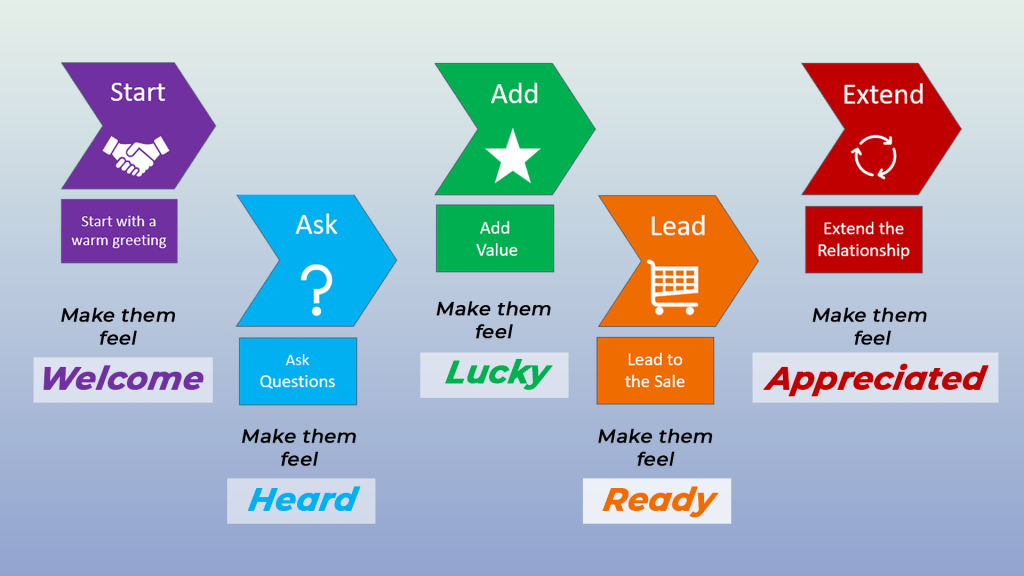
Solution: “Sales Success Workshop” began as a lesson plan for a 2-day workforce development workshop with no materials. I developed a graphic for the SAALE model (Start, Ask, Add, Lead, Extend), and a photoshop based graphic poster for each step. I incorporated those into a slide deck for the workshop, coordinating the colors and visuals with the SAALE graphics. To demonstrate the skills I scripted, filmed, and edited 2 videos that introduce the Sales Success process at the beginning of the workshop.
Walden Course Title: Multimedia Authoring Tools
Tools: Photoshop, PowerPoint, Camtasia